DigiPen isn’t your typical college, and our course catalogue reflects that. In our Class Select series, we’ll explore a few of the many interesting and unusual courses we offer our students.
When ChatGPT, Gemini, or Claude streams text across the screen, answering your questions and executing tasks in real time, what’s actually happening behind that typewriter effect? What are those mysterious “tokens” everyone keeps mentioning, and how do AI models generate them?
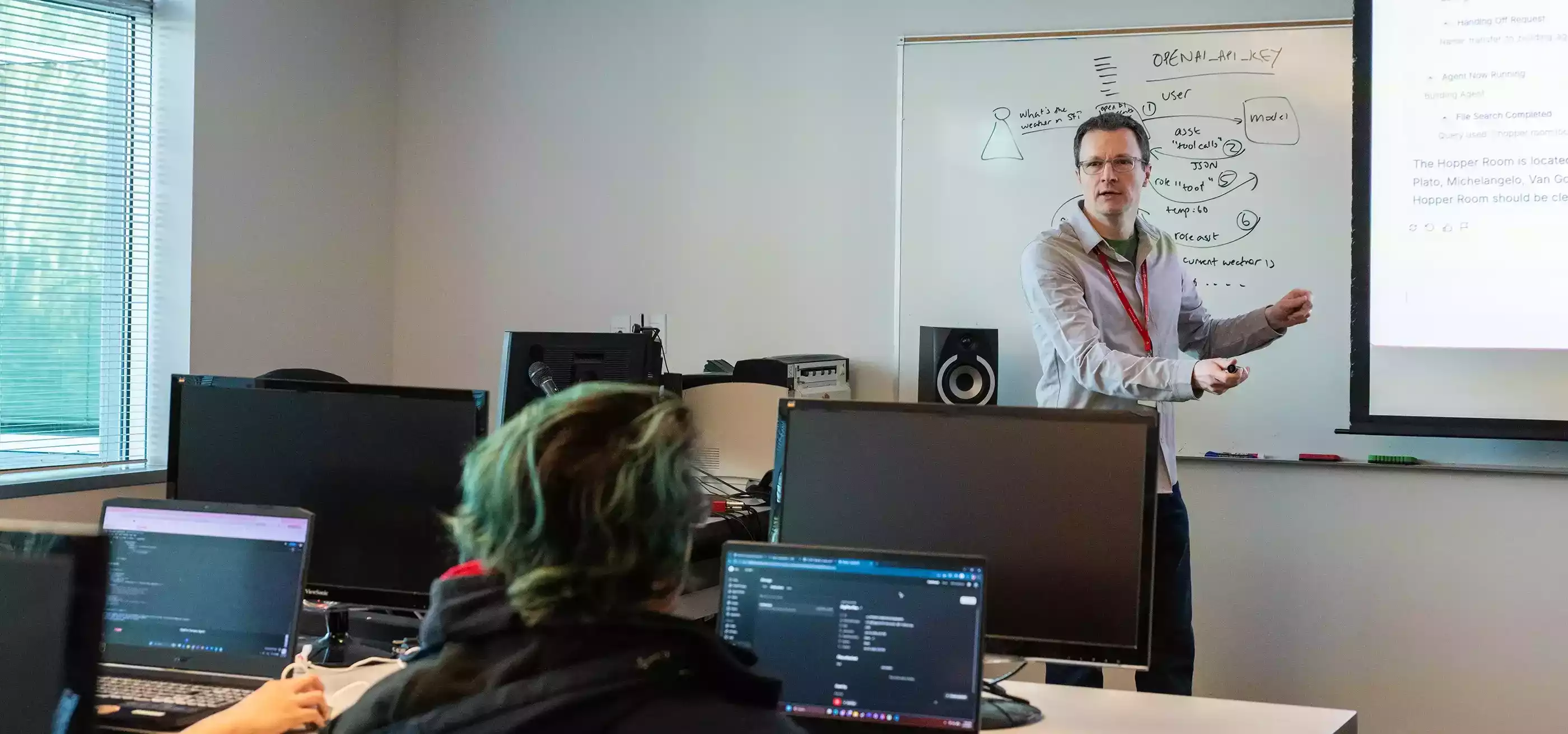
In his new course, Simon Guest is pulling back the curtain on generative AI and giving DigiPen students the power to create their own from scratch.
A 25-year software engineering veteran from Amazon and Microsoft, former Chief Technology Officer at K-12 tech education non-profit Code.org, and current adjunct professor at DigiPen, Guest saw a critical gap in how AI is being taught. “There’s a lot of emphasis on ‘prompt engineering,’ writing paragraphs to get AI to do X, Y, or Z,” he explains. “But I’m trying to go a level beyond that and tease out: How does this actually work? What’s the technology behind this, and how can you use that knowledge to build your own AI agent?”
That vacuum, along with the launch of the updated BS in Computer Science in Artificial Intelligence degree, inspired Guest to create CS 394/594 How Generative AI Works, a brand new DigiPen course that debuted in Spring 2026. The undergraduate and graduate level offering equips students with serious under-the-hood knowledge to harness both massive commercial AI models and their own small, custom-built models for game development and beyond.
“I’m trying to keep it as hands-on and practical as possible so students aren’t just learning the math or theory, but are ultimately creating something they’re excited to use,” Guest says. “We’re only in week two of the course and already students are coming up to me and saying, ‘I’ve got this idea for a final project!’”
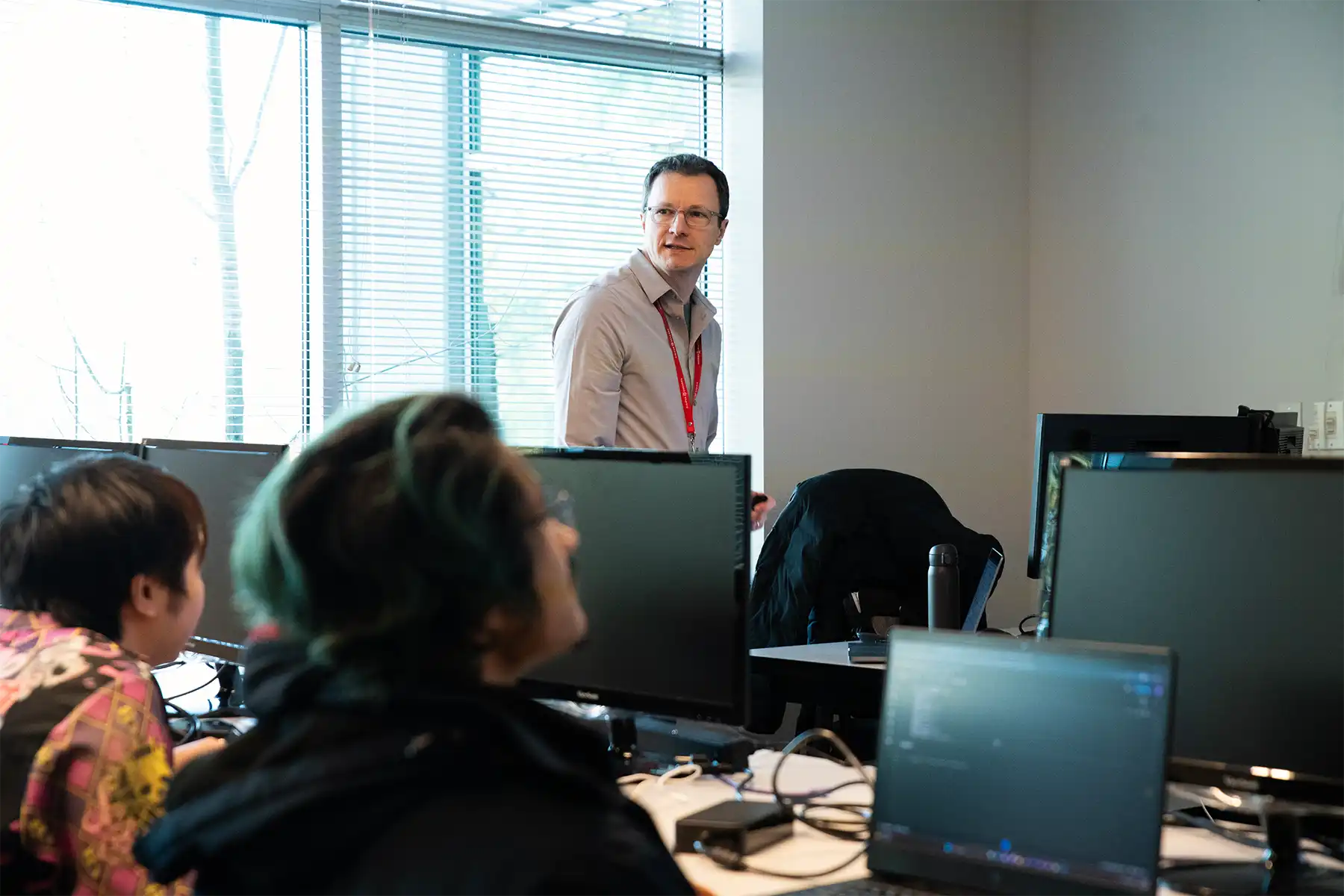
Students kick things off by digging into the history of generative AI and learning how the technology behind it works at a foundational level. Next up, they use larger online AI models to build simple chatbots and understand how developers interact with them through APIs, the interfaces that let different software programs talk to each other. Guest also shows students how AI can act like “agents” that use tools, work together, and retrieve information to solve problems, as well as manipulate and generate multimedia like images and video.
Armed with all this knowledge, students then learn to craft their own, smaller AI models, hosted on their very own computers. “We’re not teaching them how to recreate ChatGPT, but more asking: if I have a small model running on a gaming PC within a game, what kind of things does that open up?” Guest says.
The possibilities are endless. Non-player characters with non-scripted, open-ended dialogue. Procedurally generated environments that could produce infinite game worlds. Tools that can intelligently transform artwork into hyper-realistic 3D assets. “There are some really unique opportunities out there to extend or enhance games through AI, and probably many more that I’m sure the students will come up with!” Guest says. “We’re really only just starting to scratch the surface of what’s possible.”
Students learn how to embed AI models directly into game engines like Unity or Unreal using C++ or C#, weighing the tradeoffs between using their own small custom models and larger commercial or open-source alternatives.
“If you’re calling bigger models, you’re going to get much richer results, but you’re also going to incur some real costs and latency, which can be a problem if your game is incredibly popular and millions of players are calling the model at once,” Guest explains. “Smaller custom embedded models have the opposite problem: there’s almost no latency or costs, but you have to be a lot more directed in fine tuning the model to do what you want.”
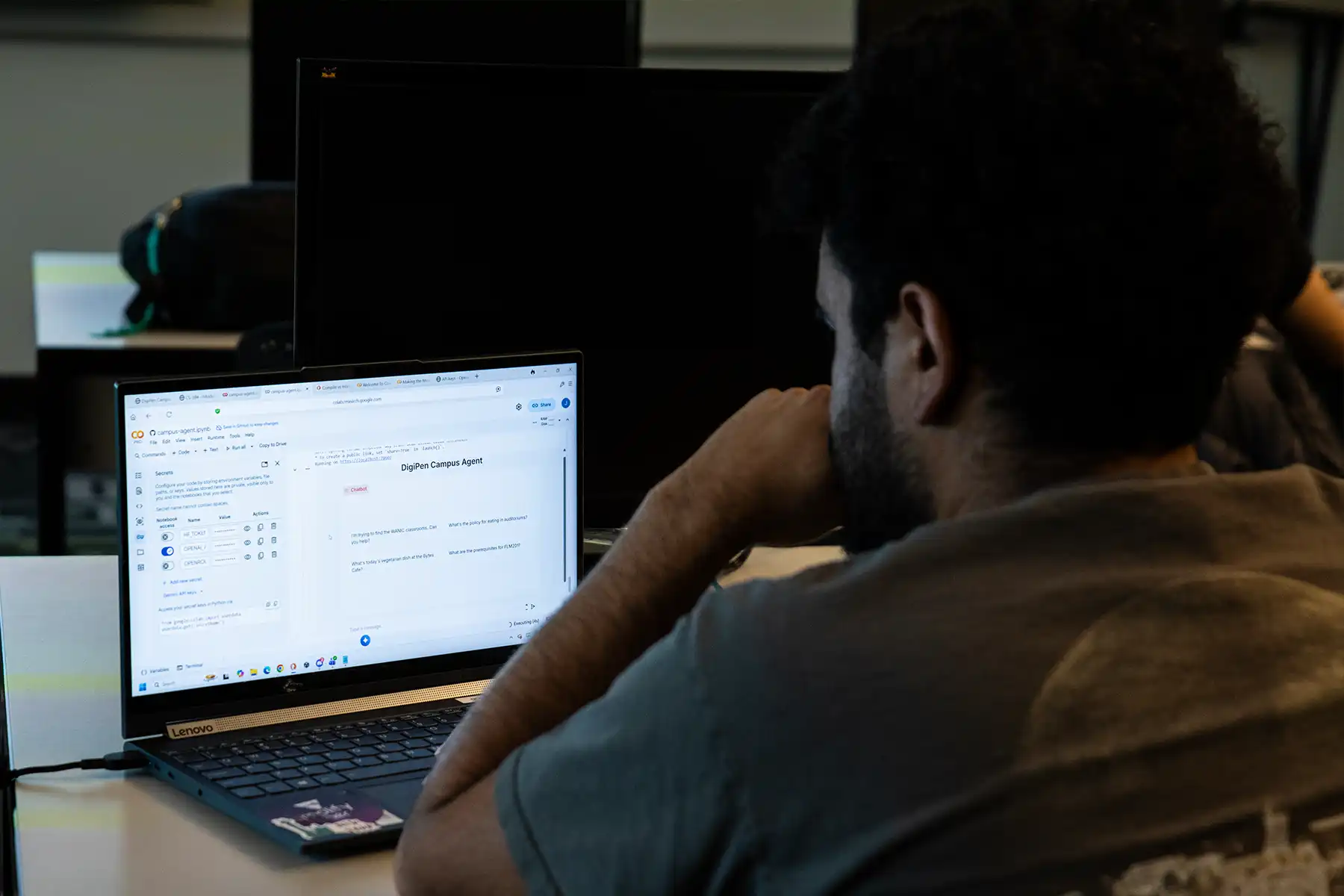
Students master that fine-tuning process in the course as well, learning how to minimize “hallucinations” (when AI confidently makes things up) and boost accuracy through training techniques, dataset curation, and targeted evaluation methods. It all builds toward a final project with one very open-ended goal: develop something creative and innovative integrating at least two of the generative AI techniques learned in the course. “There’s already a number of ideas students have pitched me that I’m super excited to see,” Guest says.
As thrilling as generative AI and its rapid advancement is, Guest doesn’t dodge the tough questions with his students. “There’s a big section of the course dedicated to ethics. We spend an entire module on it and weave the three core pillars of ethics, IP, and safety throughout the entire curriculum,” Guest says. Students investigate concerns raised in the media about AI, writing a paper that either supports or challenges specific claims using evidence-based research. They’re also required to evaluate the ethical dimensions of their own final projects.
I think students could benefit greatly from using models to build upon and enhance their creativity and existing skills rather than just replacing them.
While Guest wants students to make up their own minds about the technology, he personally thinks about AI’s potential in two ways: automation or augmentation. “Automation would be telling ChatGPT to generate a picture of a dragon, it’s got to be red, and it’s got to have this specific background. That’s not the purpose of this course, and I’m not interested in replacing artists,” he says.
Instead, Guest focuses on teaching AI as a tool to augment human potential, giving students’ existing talents a serious boost. “I think students could benefit greatly from using models to build upon and enhance their creativity and existing skills rather than just replacing them,” he says. “Hopefully, the course will help students not to bury their heads in the sand about this technology or be frightened that they are being replaced by AI. They’ll understand what’s out there, how it works, what it’s actually good at, and what it’s not so good at.”
Guest says he talks about this philosophy frequently with his own son, a current BA in Music and Sound Design student at DigiPen. “I asked him if he’d explored the current generative AI audio models, and we actually sat down and ran through a few of them,” Guest recalls. “He went, ‘Wow, the models for sound effects are a lot more capable than I thought,’ and that triggered him to think about how he could use them in his own work.”
The music models, on the other hand? “Absolutely terrible,” Guest laughs. “They could not hold a tune or melody at all!”