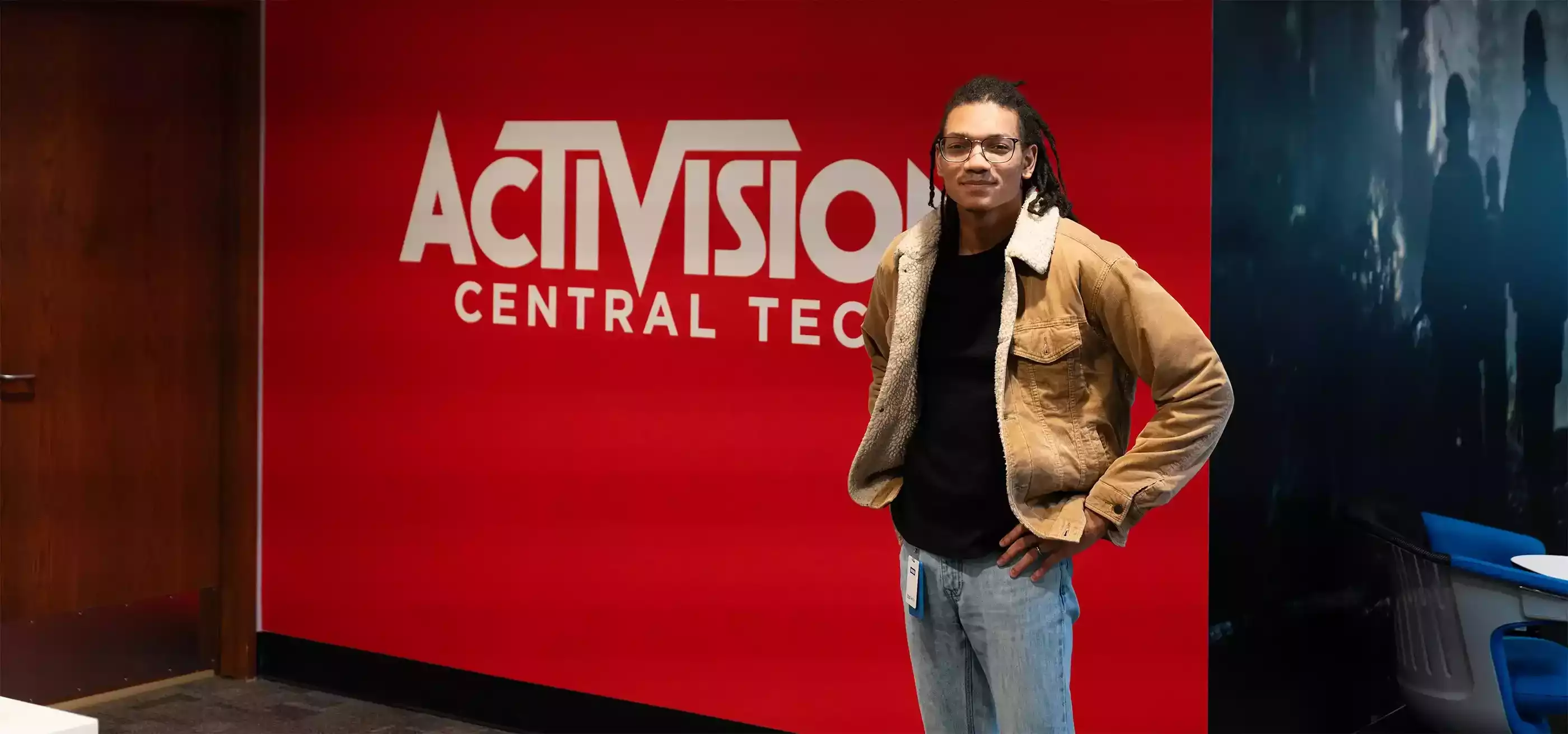
Whether he was developing his own Flash game in middle school or tinkering away in the newly released Call of Duty: Black Ops 7, solving problems is something BS in Computer Science graduate Shareef Raheem has always sought out. “I love working within the performance constraints that are needed by video games,” he says. “I approach games not just as a game developer, but also a computer scientist.”
As a Senior Software Engineer at Activision, Raheem has been contributing to the last five Call of Duty games. His work on core pipeline tools, like level editors and map compilers, allows designers and developers to see their work in the game’s engine. Streamlining processes and improving iteration speeds play a role too, but it’s more than just moving data where it needs to go — it’s about finding the best way to optimize the full experience. “Call of Duty has a lot of data, and we have to convert it into compact byte streams that can be efficiently loaded by the runtime,” says Raheem. “It’s all about transforming unoptimized, easily editable data into a format that is fast and easy to load for every platform it runs on, and this is where my problem-solving gets to shine.”
![An armored woman and armored man run through an urban battlefield in the Express map.]](/sites/default/files/public/img/news/05-body/shareef-refines-workflow-black-ops-7-body2.webp)
In recent Call of Duty releases, including Black Ops 7, Raheem has expanded the pipeline for map validation, a process where designers and developers pass map changes through tools he wrote to check for bugs and errors, like duplicated content and misplaced objects. This directly supports more accurate pipelines for level designers and world builders. “These workflows add more variety in the models and visual details across our maps,” he says. “I supported our game designers by refining the tools they use to make variations of the decal system, which means it’s easier to produce rich and non-repetitive content in the engine.”
Like any problem-solving role, there were some early pain points. “When I first got hired, I accidentally broke our map saving code and corrupted map files, and I quickly learned how our team properly tests things thoroughly!” says Raheem. After overcoming a few early challenges, he learned to turn pain points into opportunities for improvement. “Recently I was able to help support map validation changes, which meant optimizing code that normally takes around 20 minutes to validate. This could be challenging for designers when they submit a small change, but now it’s under two minutes, so it’s enough to go grab a coffee and come back.”
His love for compilers and the little efficiencies that improve them can be traced back to his fascination with computer science as a teenager. With access to free Flash games online, like his personal favorite Fancy Pants, Raheem took it upon himself to peek behind the curtain and see how to reproduce the physics that were powering these browser-based games. “I started off making Flash games as a kid, and they weren’t good at all!” says Raheem. “I made a wizard platformer game where you move the ground with your mouse to solve puzzles. Another game I made was a fake operating system where you can drag and resize windows.”
![Two cabins and a wooden boat stand amid an icy landscape and the northern lights in the Homestead map.]](/sites/default/files/public/img/news/05-body/shareef-refines-workflow-black-ops-7-body3.webp)
That fascination grew, and Raheem knew he was in love with computer science by the end of high school. It wasn’t long before he found himself on DigiPen’s website reading about student games and their experiences with physics-based programming. Soon after, he enrolled in the BS in Computer Science degree program.
“I really enjoyed CS 211 Introduction to Databases and how it showed me the relational model of organizing data,” says Raheem. “I think about data layouts in my career all the time, so it’s super important to have organized data relationships for code optimization and data analysis.”
A deeper understanding of organized data also proved useful for DigiPen’s yearly game team projects, especially in student games like Project: Gemini and Metamorphos, where Raheem is credited as a technical director. “Writing custom engines is very applicable to my work today,” he says. “Call of Duty uses its own tech, and because of DigiPen, I’ve gotten very used to bespoke code.”
After attending a DigiPen career fair, Raheem got in contact with recruiters from Nintendo and was set up with an internship with the gaming giant his junior year. His passion for compilers in his resume was standout detail, and he was swiftly brought on to help assist the build performance of the compiler for the Nintendo Switch. “The compiler uses the LLVM library and that takes a really long time to compile,” he says. This lengthy process could take hours to complete, but his work over the summer helped reduce that timeframe by about 10%.
![A humanoid robot overlooks a futuristic neighborhood in the Nuketown 2025 map.]]](/sites/default/files/public/img/news/05-body/shareef-refines-workflow-black-ops-7-body1.webp)
With experience at Nintendo and a rich showcase of game projects from his time as a DigiPen student, Raheem’s venture into the world of Call of Duty started when he was contacted by a former DigiPen alum at Activision in 2021. “I was always into RPGs and games like The Legend of Zelda, but I wasn’t always an avid FPS fan,” he says. “I was well-aware of Call of Duty, and now I have a deeper appreciation of its scale and complexity.”
Even though Call of Duty: Black Ops 7 only recently launched, Raheem is already focused on the future. “My brain is always thinking one step ahead,” says Raheem. “How can I continue learning going forward and what kind of problems will I solve next?