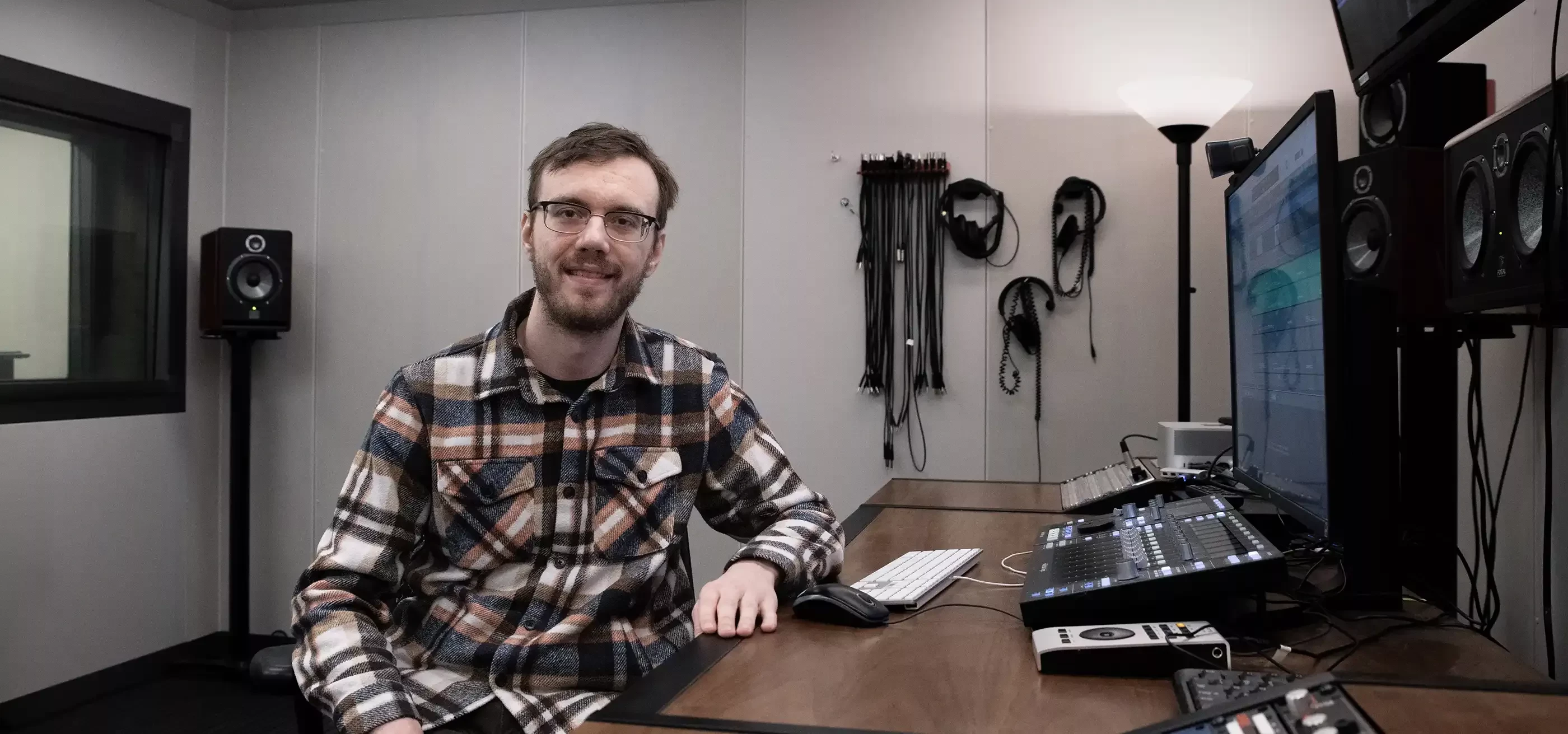
Spatial audio company Embody makes Immerse Gamepacks, video game add-ons that do exactly what the name promises — transforming ordinary headphone audio into an immersive, three-dimensional soundscape. Instead of feeling “glued to your head,” as spatial audio software engineer Caleb Klomparens puts it, sound seems to emanate from real, physical locations in the space around you. Klomparens, a 2019 BS in Computer Science and Digital Audio graduate now working at Embody, says the effect is so convincing that players using it in titles like Call of Duty, Cyberpunk 2077, and Sea of Thieves might get startled if they’re not prepared. “You kind of just have to hear it to believe it,” he says. “Something coming up behind you can trigger your fight-or-flight response. If you’re not ready for it, it can be a real jolt!”
A lifelong music maker, Klomparens got the “jolt” that would set him on his audio software engineering path in DigiPen’s K-12 ProjectFUN (now Open World) summer STEAM workshops. “I never knew programming was going to be my thing until I took the Video Game Programming I ProjectFUN course, and at that point it was clear that programming was probably going to be a big part of my life,” Klomparens says. When it was time to go to college, DigiPen’s BS in Computer Science and Digital Audio program made its debut, marrying Klomparens’ two passions in one degree. “It seemed like a no-brainer to take this route that combined the worlds of music and programming, and looking back, it was definitely the right call. It feels like home,” he says.
Klomparens’ first run-in with the concept of spatial audio came during the DigiPen Audio Symposium on campus, an event featuring a mix of faculty and industry audio leaders presenting on new technologies and special topics in the field. “One year I got to hear about this concept of spatial sound, and one of the demos passed around was a portable stereo speaker that applied cross-talk cancellation so you got raw binaural signals straight to your ears,” Klomparens says. The clever audio processing effect made each ear hear only what the audio engineer intended, creating a convincing 3D sound experience without headphones. “It just blew my mind that that was even possible.”
Not long after, Klomparens got a chance to develop a customized version of the effect himself in one of Dr. Matt Klassen’s special topics courses, exploring a concept that serves as the bedrock of Embody’s spatial audio technology — head-related transfer functions, better known as HRTFs. Unique to each person like a fingerprint, an HRTF is a mathematical profile of how your specific head and ear measurements shape the sound waves reaching your eardrums, which audio engineers can use to simulate realistic 3D spatial audio through headphones.
“We created custom spatial sound profiles for our own heads and a dummy head,” Klomparens says. “We had a special microphone that was basically like an earbud you inserted in your ear that also doubled as a microphone, so that was how you could get a rough capture of your HRTF. I remember being quite amazed with the results, it was very cool!”
When users buy an Immerse Gamepack, they generate their own HRTF profile as well — but thanks to Embody’s innovative spatial audio tool, no special earbud microphones are required. Players simply hold their phone camera up to their ears for a 10 second scan and the custom-built AI does the rest. “Suddenly, you have a personalized sound profile,” Klomparens grins. “Using machine learning research and a lot of in-house development, we’ve found a way to create really nice personalized profiles based on this very short recording session. The result is basically like having your own personal surround sound home theater built into your headphones.”
Klomparens’ role puts him on Embody’s systems team, responsible for integrating the company’s spatial audio tools and products into a wide range of technologies. “For instance, we have to figure out how to hook it into the Unreal Engine and every different version of that you can imagine. From Unreal 4, 5, or 5.6.1, each subversion can have its own crazy quirks,” he says.
Available to purchase on a game-by-game basis, Immerse Gamepacks also need to function across platforms, from Windows, to Xbox, to PlayStation, adding another layer to Klomparens’ work. “PlayStation, for example, has its own unique system requirements, and because of its own internal non-disclosure agreements, you can’t find discussions about issues you run into online,” Klomparens says. “Something that might work fine on another platform will make the app freeze on your console and you’re left wondering what happened without any information!”
Counterintuitively, Klomparens says problem solving arcane issues like these is actually his favorite aspect of working at Embody. “It’s probably one of the most fun parts of my job, the debugging sessions where I get to go in the deep end to understand why on Earth things are behaving the way they are,” he says. “It’s rarely what you’d expect! Each console has to be treated with tender love and care.”

Speaking of arcane, Klomparens says one of his proudest achievements at Embody so far has found him diving into “some really crazy metaprogramming tricks,” an advanced technique where code automatically writes other code based on variable conditions. “I helped develop this wrapper layer that’s a way cleaner way to use Embody’s tools and makes it a lot simpler to communicate across all the different features and present things clearly to the client,” Klomparens says. “I didn’t know if I was ever going to be a metaprogramming guy, but if this is my first taste of it, I’m really interested in languages that can do stuff like that! It turned out to be very useful.”
Klomparens says the signal processing mathematics and special audio topics courses he took at DigiPen laid the groundwork for much of what he does today. One lesson that has followed him was also one of the simplest — learning how to work with standard PCM audio encoding. “You know those WAV files on your computer? There’s a very precise way to open and parse the data from that specific file format, and if you know how to do that, it makes it so nice and easy to test things,” Klomparens says. “At this point I’ve done it dozens of times across different projects.” His game team courses proved equally formative, giving Klomparens hands-on experience with the audio middleware tools like Wwise and FMOD that are now a staple of his professional work. “Having that internal collaborative team environment where you actually use the technologies you’ll end up using in the future, that was crazy valuable,” he says.
Away from the office, Klomparens has channeled his twin passions for music and programming into a very different kind of project: a gingerbread pyramid with a music-synchronized light show. Developed as a showstopping entry in his family’s annual Christmastime gingerbread house-making competition, the pyramid is fitted with LEDs that flash and pulse in real time with music, using MIDI data piped from a computer through a connection to an Arduino microcontroller. The roots of that project, like so much else in Klomparens’ story, trace back to DigiPen’s ProjectFUN workshops, specifically a robotics course where he first learned to program an Arduino. “It’s a fun outlet because I’m really inspired by concert light shows and the crazy patterns people make for those,” he says. “The year before, my family had gotten very competitive with the gingerbread houses, so this was a step up!”